08 February, 2016

Porting todaybot to use extensible-effects

I wrote todaybot (blog, github) a while ago, and it is chugging along just fine, with the occasional bugfix (e.g. due to people writing Swedish).

I've been meaning to play with the Haskell extensible-effects package, so on a lazy Sunday afternoon I started hacking away porting todaybot. My goal was more to get a hands-on feel for extensible-effects rather than actually replace the existing todaybot implementation.

The existing non-effect-based code is pretty rough-and-ready/script-like. It all runs in the IO monad, and state is threaded round manually in a couple of places.

I started by replacing all the IO actions with calls to the (Lift IO) effect. The problems I encountered here were:

  • type signatures/type checking errors, with initially impenetrable type errors (reminiscent of what happens when you work with Lens). The constraint based style of effect types gives verbose type errors in a form that I was not used to.
  • Some interaction that I haven't understood between type signatures/type inference on effects and on lens types and parsec types(!). I needed to add type signatures on top level lens and parser definitions, which I got using typed holes.
  • Handling IO exceptions - I was unsure how exceptions would work so for this first cut I ignored exception handling and let the whole bot die if anything goes wrong.

So now I had a bot with a single effect, Lift IO, with worse error handling than before. I wanted to get this exception handling back in so I wasn't losing functionality. I didn't (and still don't) know of the idiomatic way to handle IO exceptions in (Lift IO).

extensible-effects has exceptions (Exc) already, and I wanted IO exceptions to be handled using those, with the Exc IOError effect. I made a wrapper for lift, called lift' which called an IO action and translated IO errors into Exc IOError exceptions. IO errors then could be handled straightforwardly. Later on it turned out this wasn't enough: code is throwing errors other than IOError which need to be caught (although maybe this is also a bug in the mainline todaybot).

Next, I wanted to start breaking down the use of the IO effect into more focused effects. The one people talk about a lot is logging. There's a Writer effect in extensible-effects already, and logging by writing a string seemed pretty obvious. There's also a Trace effect which is pretty similar. Neither had effect handlers that did what I want: translate the logging effect into IO effects (which in turn would be handled by the IO effect handler). This was pretty straightforward to write, though. There was some messing round with type signatures but I got it worked out in the end.

And the last bit I did before I went to bed was put in a couple of Reader effects: one for configuration (which comes from a YAML file), and one for the authentication bearer token, which is requested during runtime. Writing the handlers for these had a similar feel to writing the handler for logging - a few lines of code inserted into boilerplate, messing round with type errors, raising more questions that I might get round to writing about.

Next I would like to implement effects to handle the last two pieces of IO, which are are access to the current time, and HTTP GET/POST calls; and see if I can use a choice effet instead of mapM_ to iterate.

The (very messy) code is on the exteff branch on github - at the time of writing, up to commit 7ccc0a92....

06 July, 2015

A Haskell reddit bot.

I am one of many many moderators on reddit's r/LondonSocialClub. This is a place for organising social gatherings in London.

Post titles usually take the form [DD/MM/YY] Event @ Place. Other moderators have fiddled with the CSS for this subreddit to give us a big red TODAY sticker next to today's events, and grey out events that are in the past. This uses reddit's flair mechanism, which allows assigning of labels to posts, and CSS styling based on a post's flair.

Unfortunately, this was not entirely automated - some sucker or other had to go in each day and adjust flair on the relevant posts to match up with reality. This bothered me as being a manual process that should be fairly easily automated. Eventually it bothered me enough that I wrote a bot, lsc-todaybot, to do it. Now the moderation logs make it look like I come home from the pub every day and move everything around before going to sleep.

Another motivation for writing this bot was it seemed small enough in scope that it would be achievable, but give me a chance to learn a few new APIs: several new Haskell libraries, and the reddit REST API.

HTTP: I've previously used HTTP when hacking at cabal. This doesn't do HTTPS (I think) and the maintainer told me to not use it. So I tried wreq. It was easy enough to get going and there was a tutorial for me to rip off.

Configuration: I used yaml to parse a YAML configuration file.

Lenses: I still haven't got a good grasp on what is happening with lenses but I used them in a few places, and it has developed my understanding a little bit: lsc-todaybot extracts fields from reddit's JSON responses using aeson-lens. yaml exposes the parsed configuration file as JSON, so the same lenses can be used for extracting configuration details. wreq also uses lenses for setting HTTP header values and the like.

Strings: I seem to have ended up using several different string classes, which is icky - ByteString, Text and String at least. I've made the source code for that more generic by using the generic monoid <> operator to concatenate them which makes things a bit less horrible looking.

--

28 May, 2015

10 minute Haskell talk: An awkward interaction between lazy ByteStrings and a misbehaving (non-)transparent HTTP middlebox

The slides for a lightning talk I gave at the London Haskell User Group are here. Press a in the browser and you'll get some explanatory notes with the slides; otherwise they're a bit sparse.

01 December, 2014

dive computer subtitles for gopro videos

On a couple of dives recently, I had my own dive computer and wore my GoPro in head-mounted mode.

I thought it would be nice to have the dive computer info displayed on the GoPro video, so I hacked up https://github.com/benclifford/subsurface2srt which pulls data from subsurface and makes it into a VLC subtitles file.

One problem I have is that both the GoPro and the dive computer have manually set clocks, which can be set only to the nearest minute. So guessing a start offset between the video and the dive computer file is a bit hazy.

04 November, 2014

plane wifi

I was on a plane that had wifi for the first time. I think a 777-200 or something like it.

I didn't have much battery power left on my laptop and I didn't want to pay USD16 for just a few minutes; but I did have a poke around the network.

My laptop could see 2 access points with ESSID United_Wi-Fi and 10 with a blank ESSID.

I connected to one of the United_Wi-Fi APs.

They used NAT (I expect) and allocated me an RFC1918 address in subnet with about 500 usable IPs.

inet addr:172.19.248.97  Bcast:172.19.249.255  Mask:255.255.254.0
With each passenger carrying at least one wifi device, I wonder if they'll get near address space exhaustion. A 777 is supposed to be able to carry up to about 450 passengers in some configurations.

The default gateway is down at 172.19.248.1

There is a suggestion that DNS paywall tunnel hacks might work, though I didn't try - some hostname lookups gave me an IP address, and some gave an NXDOMAIN which suggests there is some off-plane communication happening even though the paywall was still in place.

$ host www.google.com
www.google.com has address 74.125.225.51
[...]
$ host blahfkskfdhs.com
Host blahfkskfdhs.com not found: 3(NXDOMAIN)

http GETs were all redirected to www.unitedwifi.com, hosted on-plane at 172.19.248.2.

An nmap of the 172.19.248.0/23 subnet gave 19 addresses responding to pings - I guess mostly passengers, but I guess crew too, and servers/routers.

The three interesting nmap results were:

Nmap scan report for ns.unitedwifi.com (172.19.248.1)
Host is up (0.0020s latency).
Not shown: 997 filtered ports
PORT    STATE  SERVICE
53/tcp  open   domain
80/tcp  open   http
443/tcp closed https
MAC Address: 00:0D:2E:00:40:01 (Matsushita Avionics Systems)

Nmap scan report for www.unitedwifi.com (172.19.248.2)
Host is up (0.0014s latency).
Not shown: 993 filtered ports
PORT      STATE  SERVICE
80/tcp    open   http
443/tcp   open   https
8080/tcp  closed http-proxy
16001/tcp closed fmsascon
16012/tcp closed unknown
16016/tcp closed unknown
16018/tcp closed unknown
MAC Address: 00:0D:2E:00:00:A8 (Matsushita Avionics Systems)

Nmap scan report for 172.19.248.3
Host is up (0.0019s latency).
Not shown: 999 filtered ports
PORT   STATE SERVICE
53/tcp open  domain
MAC Address: 00:0D:2E:00:40:01 (Matsushita Avionics Systems)

I didn't probe any more as my battery had run out.

30 September, 2014

Payment Wristband on the London Underground

I previously blogged about making a paytag sticker into a wristband. Later Barclays Bank released a variation: bpay, a prepay mastercard already in a wristband.

The wristband holder is pretty shitty and falloffable: it is bulky and I know two people (one being myself) who have lost their bands accidentally. I've rehoused mine on a woven bracelet.

Being a pre-pay band, this chip does an online authorisation for every transaction, making it sometimes a little slower. But for the same reason, they expose authorisations (not just cleared transactions) in their live online statement.

I recently made my first journey on the London Overground using bpay (I've been on their contactless payment trial for 6 months but using a different card) and I got to see an initial authorisation that I hadn't seen before with my previous (post-paid) card:

0908 Enter train system at Wapping station
0915 bpay sees this authorization:
Auth: TfL Travel Charge,TFL.gov.uk/CP,GB 29/09/2014 9:14:50 Posted On: 29/09/2014 GBP 0.10
0922 Leave train system at Shoreditch High Street
then around close of business on day+1, that Auth gets replaced with the actual charge:
    Fin: TFL.GOV.UK/CP,VICTORIA,TFL TRAVEL C   30/09/2014  18:07:58  Posted On: 29/09/2014  GBP 7.20

Interesting that they charge 10p for authorization rather than the minimum single fare. Also note that the description of the transaction changes (to something less readable, IMO) - that seems to happen from other merchants too. Weirdos.

02 September, 2014

Boris bike tidal flow

Docking status information is available in XML for the London bike hire scheme ("Boris bikes").

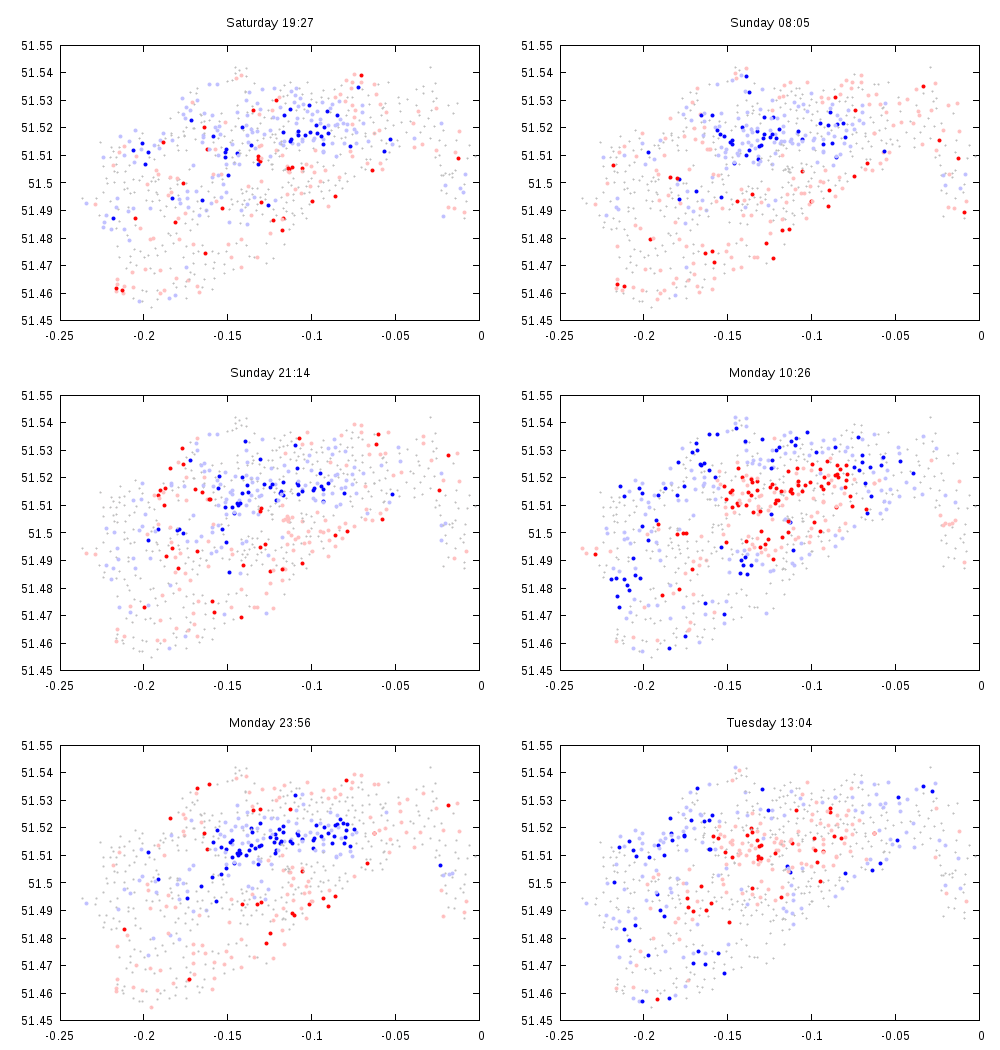
I made this video (AVI) (animated GIF) of tidal flow as areas get busy or empty during the day, an animated version of the image below using data from Saturday evening until Tuesday lunchtime.

Each point represents a docking station. You can see how the shape of this cloud sits over London on this Google map. Blue means empty docking station. Red means full docking station. Light blue and light red mean almost empty and almost full, respectively.

Not so much on Saturday and Sunday, but clearly (to me) on Monday you can see a 9am rush hour move of bikes into the centre, and a 5pm move of bikes back out to the edges again.

27 August, 2014

ffmpeg X video capture...

It turns out ffmpeg can video-record an X server. I'm using this to capture video of a set of web browsers running tests inside Xvfb virtual frame buffers.
ffmpeg -f x11grab -s 1024x768 -r 4 -i :1 -sameq screencast.flv &
VIDEOPID=$!
xeyes # or some other X-based automated testing program
kill $VIDEOPID

05 August, 2014

ping reverse dns

Slightly unexpected hostname lookup on a CNAME.

maven.op is a CNAME to lulu; the reverse DNS points only to lulu.

Someone has already figured out the lulu hostname by the first line of output because it's shown there. But the ping lines for a few seconds show the name I gave and then turn to the "real" hostname (perhaps when a reverse DNS happens? rather than using the name that we looked up forward-wise to begin with?)

No big deal, but slightly unexpected.

benc@utsire:~$ ping maven.ops.xeus.co.uk
PING lulu.xeus.co.uk (46.4.100.47) 56(84) bytes of data.
64 bytes from maven.ops.xeus.co.uk (46.4.100.47): icmp_req=1 ttl=51 time=466 ms
64 bytes from maven.ops.xeus.co.uk (46.4.100.47): icmp_req=2 ttl=51 time=51.1 ms
64 bytes from maven.ops.xeus.co.uk (46.4.100.47): icmp_req=3 ttl=51 time=51.9 ms
64 bytes from lulu.xeus.co.uk (46.4.100.47): icmp_req=4 ttl=51 time=60.1 ms
64 bytes from lulu.xeus.co.uk (46.4.100.47): icmp_req=5 ttl=51 time=96.5 ms
64 bytes from lulu.xeus.co.uk (46.4.100.47): icmp_req=6 ttl=51 time=50.9 ms
64 bytes from lulu.xeus.co.uk (46.4.100.47): icmp_req=7 ttl=51 time=49.5 ms
64 bytes from lulu.xeus.co.uk (46.4.100.47): icmp_req=8 ttl=51 time=50.6 ms

benc@utsire:~$ ping -V
ping utility, iputils-sss20101006

15 July, 2014

containerisation of my own environment

I've encountered docker in a couple of work-related projects, and for a bit more experimentation I've begun containerising a chunk of my own infrastructure.

Previously I've had a few servers around which over the years have ended up with me being a bit scared to upgrade: too many dependencies for what should be separate services. Last time I rebuilt my main server, I looked at Xen but that machine was a little bit too out of date for doing decent virtualisation: having a bunch of different VMs was at the time the best way I could see for doing this.

I've ended up with an LDAP server for unix accounts, and a /home shared between all the containers that need home directory access (which is done with docker volume mounts at the moment, but there is scope for adding NFS onto that if/when I spread to more than one machine).

I've got separate containers for each of: inbound smtp, outbound smtp, an apache proxy that redirects to other containers based on URL, imap, webmail, ldap server, ssh server (so you are ssh-ing into a container, not the base OS).

The plan is that each of these is built and restarted automatically every week or so; along with a whole machine reboot at least once a month. I'm hoping that keeps stuff fairly up to date and helps me discover upgrade-related breakages around the time they happen rather than years later. It also forces me to pay attention to documenting how I set something up: all the stuff that is torn down and rebuilt each time needs to be documented properly in machine-readable form, so that the rebuild works. In that sense, it is a bit like automated testing of documentation.

I've also tried to set up things like port forwarding and http forwarding so that its not too reliant on using docker - so that I can spread onto other machines or use different virtualisation. That is, for example, how I intend to deal with upgrading the base OS in a few years time - by starting a new VM, moving the services across one by one, and then killing the old one.